 Otaki Today
The Ōtaki Club & RSA is hoping to be fully open on September 15 if a public appeal continues to attract loans and donations.
As of September 7, $30,000 had been received – about half of the amount the club needs to stave off closure.
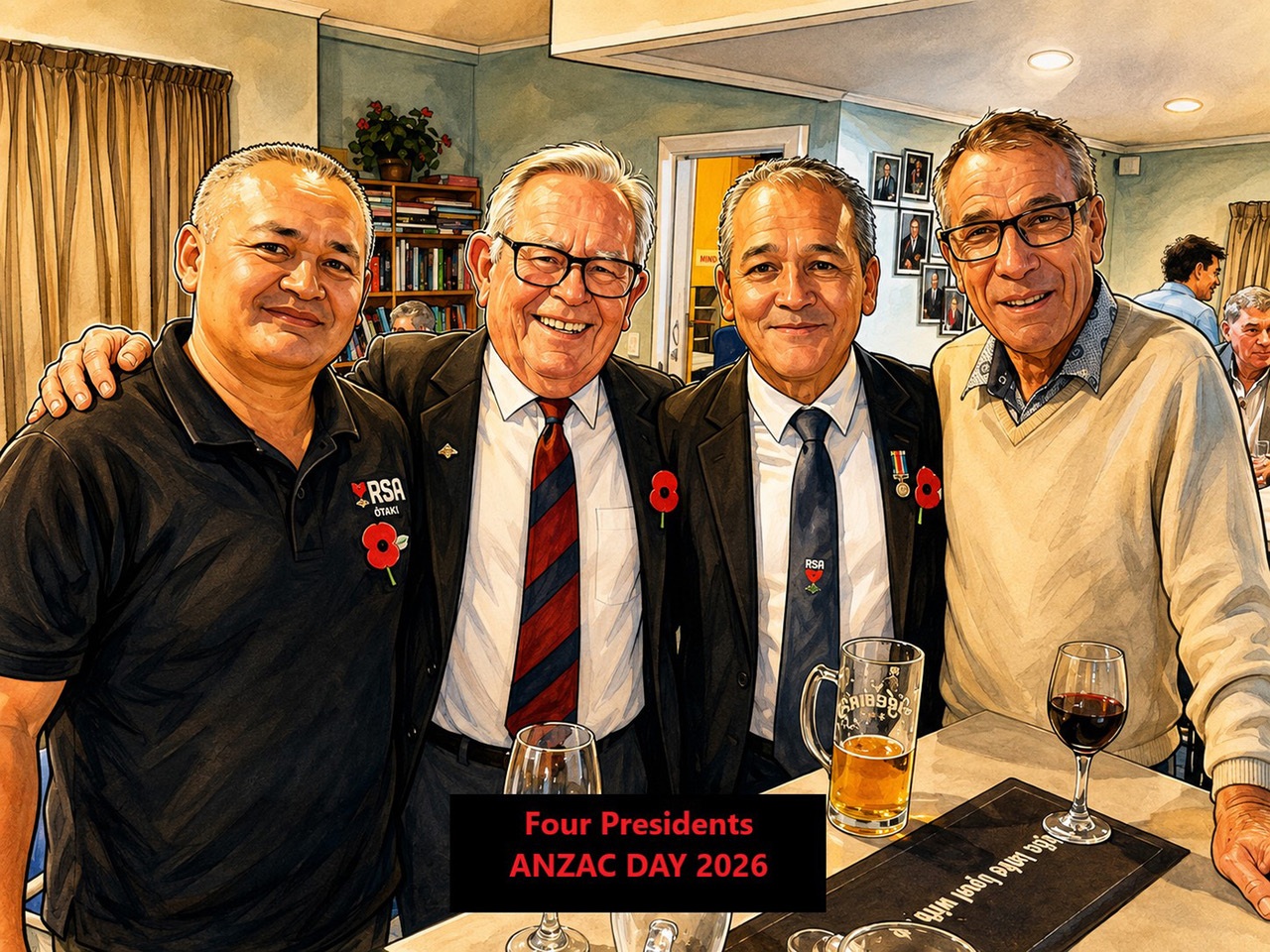
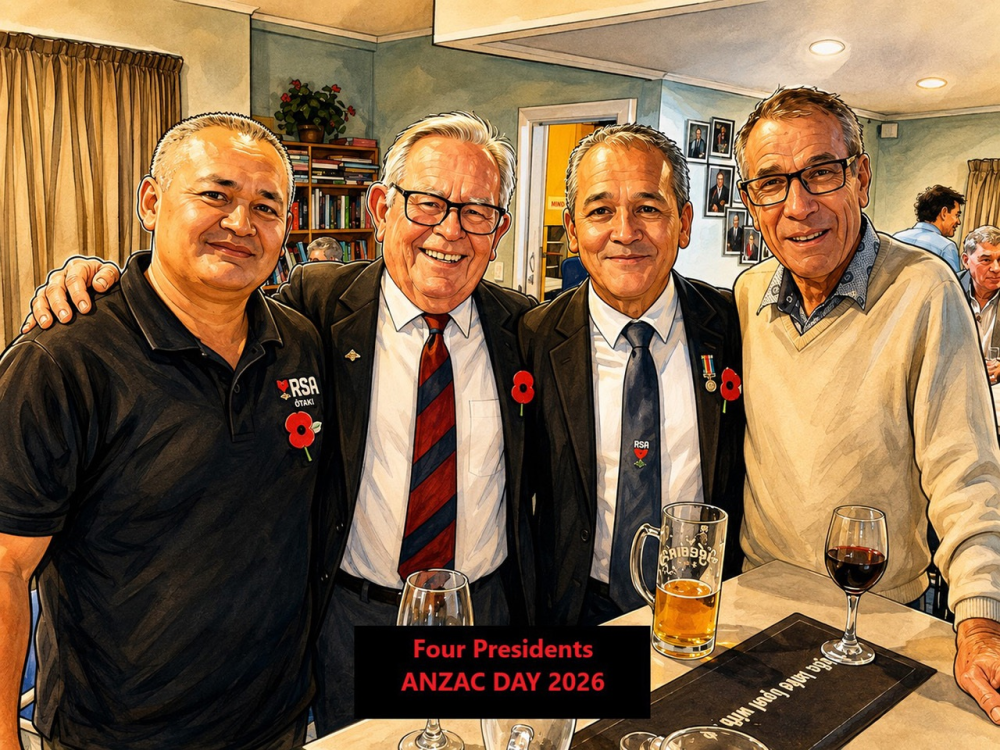
BETTER TIMES: Four recent presidents of the Ōtaki Club & RSA, from a rendered photo taken on Anzac Day, 2026. From left, Trist Reweti, Colin Robertson, Hone Underwood, and Mike Fogarty. Image supplied
About 100 people at a public meeting on Sunday, August 31, heard that the club was technically insolvent, but that plans were afoot to rescue the struggling club.
The meeting was at the Raukawa Street clubrooms of the RSA, which had already been mostly closed for two weeks in a bid to slash costs while a rescue plan was devised.
Those attending heard that for more than three years, the club’s costs had exceeded revenue. Despite efforts to reverse the deficit, poor trading in June and July brought matters to a head. Unable to service supplier costs, the club stopped orders for goods the club relied on, such as alcohol and food.
The August 31 meeting was called after two early meetings of members, in which the club committee was urged to discuss the situation with the public.
President Trist Reweti was up-front about the challenges, saying the situation meant members had some tough choices to make. However, on the positive side, many people had offered to help since the doors closed.
Costs had also been trimmed, including staff costs and the salary of general manager Te Hau. She told the meeting she had recently resigned to help the club with its cost-cutting programme.
Laying out the figures, Te Hau (surname withheld), who was appointed only 16 months ago, said the Ōtaki RSA had nearly $90,000 of debt – $55,000 in aged payables (supplier debt), and $32,000 in loans from members. Alongside that, it had running costs such as $2800 a month for power.
However, it had a strong freehold asset in the building, valued at $1.2 million, which – along with efforts by the management to become solvent again – Te Hau said were “holding off” creditors. Trist said two recent meetings of members indicated there was no desire to wind up the club, which was established in 1919 and had become an Ōtaki institution.
“That’s not an option,” he said.
Members agreed to set up a working group to pursue two options for the club:
-
Continue to trade with changes to operations.
-
Continue as an entity but sell the buildings and land.
A priority for option 1 was to clear debt as soon as possible. Re-opening full time would require most of the $55,000 supplier debt to be paid. Restocking the bar would cost up to $3000, and $4000 would be needed for payouts on the pokie machines, plus $2000 to refill the ATM.
To generate income, other groups could hire the venue, including the kitchen for commercial operations.
Apart from donations and loans, corporate sponsors would be approached to support the club. Future operations might include more volunteers, but it was also recognised that the Ōtaki RSA experience needed to entice more people into the club more regularly.
Option 2, to sell the buildings and assets, would clear the debt and allow for the purchase of another smaller building. The club would continue, but it would be unlikely to offer gambling, dining or alcohol.
A merger with another entity would be possible.
Two have expressed interest: Ōtaki Golf Club, and Waikanae Chartered Club. Members, however, have indicated they wouldn’t want to travel to Waikanae, leaving the golf club as the only viable alternative at present.
Meantime, working group member Phil Cowan has set up a “Love Ōtaki RSA” crowdfunding campaign. Using social media, it is aimed at attracting funds from businesses, individuals, and veterans worldwide. See Love Otaki RSA on Facebook.
OTHER STORIES
... loading ...