Otaki Today
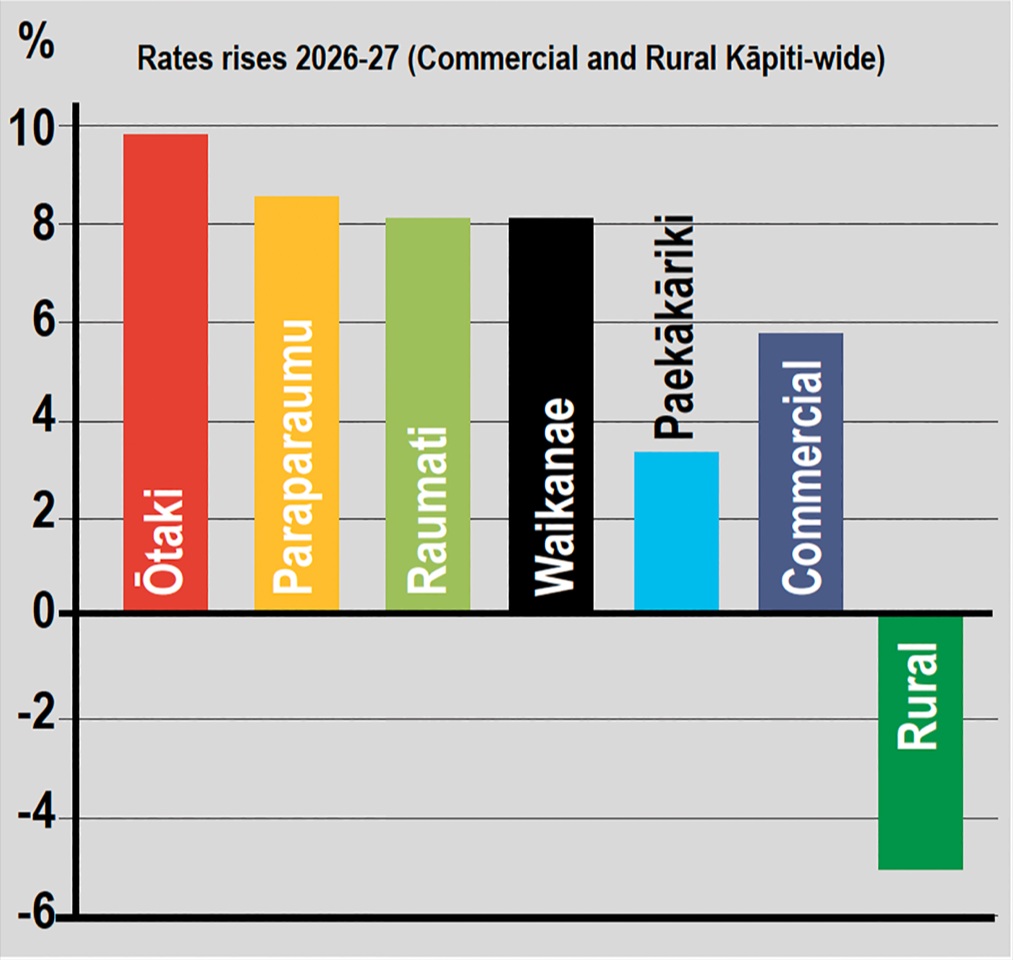
Analysis of 2026-27 rates rises for each of the main centres shows Ōtaki tops the list for Kāpiti Coast by more than 1.5 percentage points.
Council figures put Ōtaki’s median rates rise up 9.94%, well ahead of Paraparaumu at 8.42%. Raumati is 8.05%, Waikanae 8.04%, and Paekākāriki 3.5%. Commercial rates across the district will go up 5.91%, while the rural sector gets some relief with a drop of 5.02%.[1]
Median rates refer to the middle value when all properties in an area are ranked by their value. Individual property rates might be below or above the median, depending on property value, type, and location.
Rates in each area are determined by movement in property values.
In Ōtaki’s case, the rates rise is greater because values have increased more than in other areas of the district.
The average property in Ōtaki is valued at $560,000. Rates in 2025-26 were on average $4275 – they go up in 2026-27 by $425 to $4700, including GST. That equates to about $8.20 extra a week.
The dollar increase for Ōtaki is also higher than other areas of Kāpiti. In Paraparaumu the estimated median rise is about $409 a year, Raumati $405, Waikanae $400, and Paekākāriki $172.
The above figures exclude rates for Greater Wellington Regional Council. On June 25, GW said the average regional rates increase would be 9.7% for 2026-27. Residential rates (inc GST) are up on average $83.83 a year ($1.61 a week), business rates (ex GST) $695.70 ($13.38 a week), and rural rates (ex GST) $103.25 ($1.99 a week).
In Kāpiti, the median rates rise throughout the district is 6.5 percent. The council says that in the coming year it will continue work agreed with the community and keep building a resilient future for Kāpiti.
Commenting on its 6.5% median rate increase, the council says: “Like many councils, we’re balancing rising costs, and investing in essential services and infrastructure, while keeping rates affordability at the top of mind. We have made every effort to ensure we achieve this, and to do our bit to help our community in these hard times.”
It has removed $1.9 million from staff and project delivery costs, adjusted its fees and charges, and pause its planned rates debt reduction.
Where the council found savings for the Annual Plan 2026/27:
• reducing staff costs due to both organisational and project delivery changes ($660,000)
• reducing funding for the Social Investment Fund ($150,000)
• increasing fees for private plan changes ($200,000)
• reducing economic development budget ($325,000)
• reducing cultural capacity funding ($150,000)
• stopping our planned rates-funded debt reduction for one year ($400,000)
• increasing fees and charges to reflect the impact of inflation, generating an additional $300,000.
The council will still invest about $75 million in capital works in 2026/27. This includes:
• work to progress the replacement of the Paekākāriki seawall
• upgrades to the Paraparaumu Wastewater Treatment Plant
• upgrades to the Waikanae Water Treatment Plant
• planning for a second water reservoir
• installing a new bore in Ōtaki
• completing Te Ara Whetū, the new Waikanae Library upgrade
• completing the Waikanae Park upgrade.
You can find out what your estimated rates are at: bit.ly/4w5U1Mu
If you struggle to pay rates, you might be eligible for help – see bit.ly/4eKaZJn
To view the 2026-27 Annual Plan, see bit.ly/4oTem5o
OTHER STORIES
... loading ...