 Otaki Today
Civil construction company Mills Albert has got behind the Friends of the Ōtaki River with a tree planting and putting surplus topsoil to good use.
About 40 Friends and Mills Albert staff gathered on August 19 to plant native seedlings on the south bank of the river. The seedlings were all grown at the Friends’ own nursery as part of the group’s ongoing conservation work.
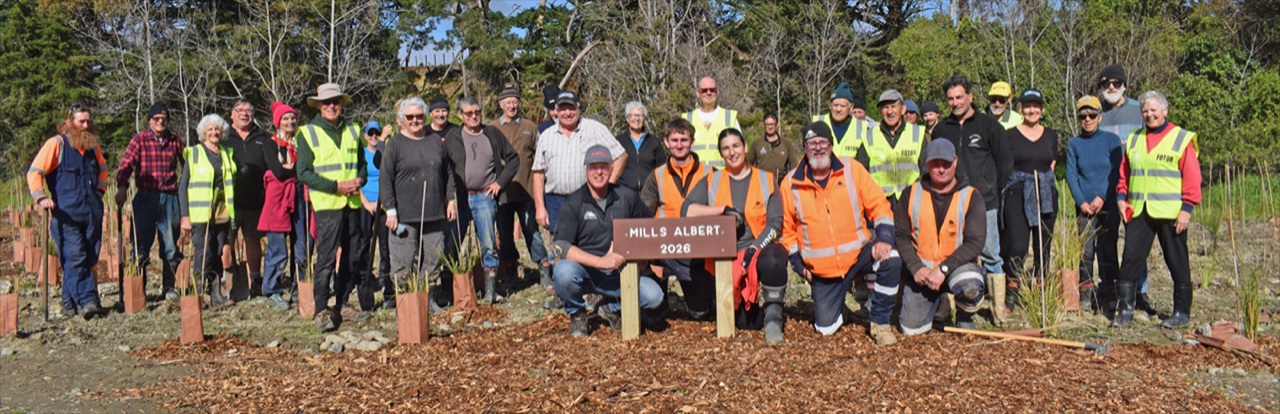
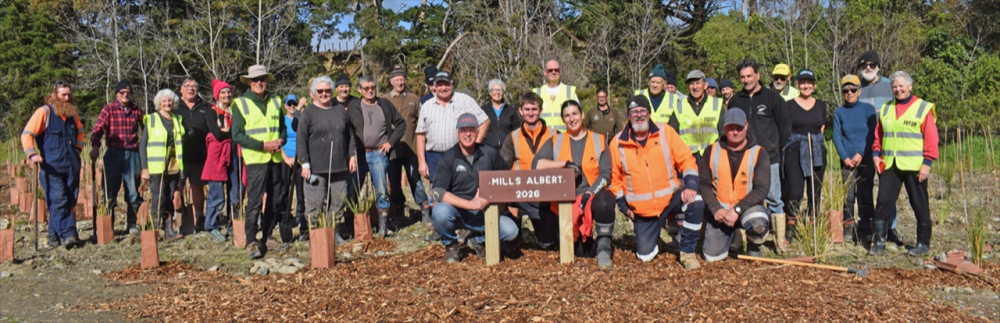
Members of the Friends of the Ōtaki River, and Mills Albert staff, at the recent planting. Photo Ōtaki Today
Friends chair Max Lutz thanked Mills Albert for its support, which included not only paying for the trees but arranging delivery of about 1000 cubic metres of topsoil to the site.
The soil was surplus material from recent works on Mill Road. Hundreds of truckloads were transported from the Mill Road depot and spread across the riverbank using a bulldozer.
Former Friends secretary Trevor Wylie played an important role in liaising between the conservation group and Mills Albert. A sign acknowledging the company’s contribution was also unveiled during the planting.
Mills Albert construction and sustainability manager Peter Jenkins said the project was a good example of business and community working together for the benefit of Ōtaki well into the future.
“This is something not just for us and our families to enjoy, but also for future generations,” he said. “This planting is going to be here for many years to come.”
He said the company was pleased to be able to support the Friends’ volunteers while also finding a productive use for the surplus soil.
“These guys [the Friends] are all volunteers, so it’s really nice to be able to give back to the community,” he said. “And the timing was great because we were able to put that topsoil somewhere useful. From a sustainability perspective, this is exactly what I like to see, because part of my role is to divert as much as I can from landfill.”
He said the company would be keen to find similar opportunities in the future.
“If we have more soil that’s good enough to plant in, this will be the first stop,” he said.
He said about 96 percent of the material excavated by Mills Albert was currently being put to use elsewhere rather than going to landfill.
OTHER STORIES
... loading ...