Otaki Today
Sam Leason has returned home to Ōtaki after what he describes as inhumane treatment in an Israeli desert terrorist prison.
Sam, 18, was on the Global Sumud Flotilla attempting to deliver aid to Gaza when it was intercepted during the night on October 1 by Israeli comandos. Sam was on the Sirius, in international waters about 75 nautical miles off the Gaza coast.
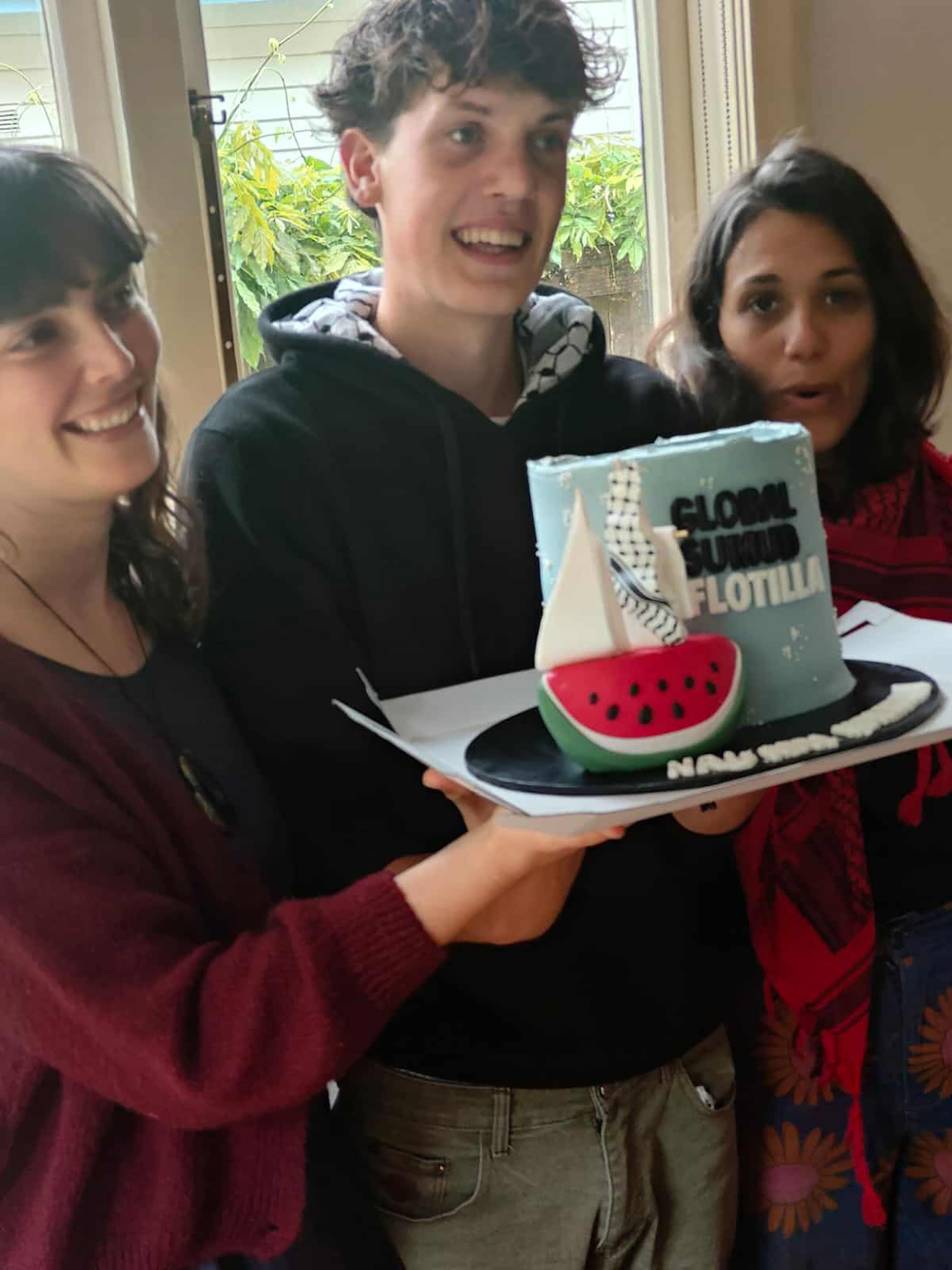
Sam Leason celebrates his home-coming in Auckland with Palestinian solidarity organisers Acacia O’Connor, left, and Eloiza Montaña. Photo supplied
“We were trying to get aid to the starving people of Gaza and break the illegal blockade,” Sam told Ōtaki Today on Sunday (October 12), the day he arrived back at his family’s Bennetts Road home. “About 8.30 at night, the Israelis boarded the boat, pointed guns in our faces, took our passports and made us sit all night on a wooden bench out on the deck” while they took the boat to Israel.
On arrival, the flotilla members had to wait in the sun to be processed.
“We had old people with us, some with disabilities, others who needed medicines. We were thirsty and hungry, but were forced to kneal in the hot sun on concrete for hours – for some it was eight hours.”
During the processing, they were strip searched and everything they had was confiscated except the clothes they wore.
“They took my pounamu, which had been given to me by my godmother, and my mandolin, which was very precious to me.”
They were then transported in what Sam describes as a “very sketchy van with scratches and stains all over it”. The prisoners, in summer clothes, were blasted with freezing air conditioning, before arriving at Ketziot Prison in the Negev Desert, southern Israel.
On a recent visit to the prison, Israel’s national security minister, Itamar Ben-Gvir, expressed his approval of the harsh conditions for international activists detained from the flotilla.
He said in comments carried by the daily Yedioth Ahronoth that he wanted to ensure they received “no special treatment” and he was “proud that we treat flotilla activists as terror supporters”.
“They should feel what the conditions in Ketziot Prison are like, and think twice before approaching Israel again. That’s how it works.”
Sam saw the minister being filmed while he and about 60 others were confined in a large outdoor cage.
“We started chanting ‘Free Palestine’.”
There was no food for 24 hours, and during his six days at Ketziot, Sam was in a cramped cell that had eight bunk beds, but often had 12 prisoners. Those without a bed slept on the floor. A single toilet served everyone, and in the first of Sam’s cells, the toilet got clogged and was not repaired.
They saw guards drinking bottled water, but with the cells so hot, had to drink from a rusty tap.
Sam says everyone was petrified of what physical mistreatment they might receive, but in the end it was psychological – “They wanted to scare us”.
He was allowed out of the cell only three times – to see British consular personnel – and that was in the large cage out in the sun.
He says they were in inhumane conditions, but “not half as bad as the conditions for the thousands of Palestinians – some of them children – imprisoned for years and often without trial”.
He is disappointed that he heard nothing and got no support from the New Zealand government. All his interactions were through the British Embassy in Tel Aviv, Israel. When he was finally released and taken to Jordan, unlike people from other nationalities, Sam had to rely on the hospitality of Jordanians and funds from the flotilla campaign to get him home.
He arrived in Auckland on Saturday (October 11).
OTHER STORIES
... loading ...