
 Otaki Today
A long-vacant butcher’s shop in Ōtaki is being given a new lease of life as a specialist paper-making studio and retail space.
Rob and Katharina Kennedy are due to open Paperscape at 78 Main Street (next to Ōtaki Pharmacy), in June. Their new premises are the first new build in Main Street for decades.
The original building, dating back to the 1920s, was unsalvageable, forcing a full rebuild after structural engineers found significant issues. If the Kennedys weren’t going to build, they would have had to do extensive earthquake strengthening.
“In the end it was a cleaner path to start again,” Katharina says.
The Kennedys bring with them years of experience turning native and non-woody plants into handcrafted paper for artists, craftspeople and the public.
They were looking at warehouses and other options around Kāpiti, but nothing sparked much imagination. Then they saw the old butcher shop in Ōtaki was for sale, and despite the building’s condition, saw potential.
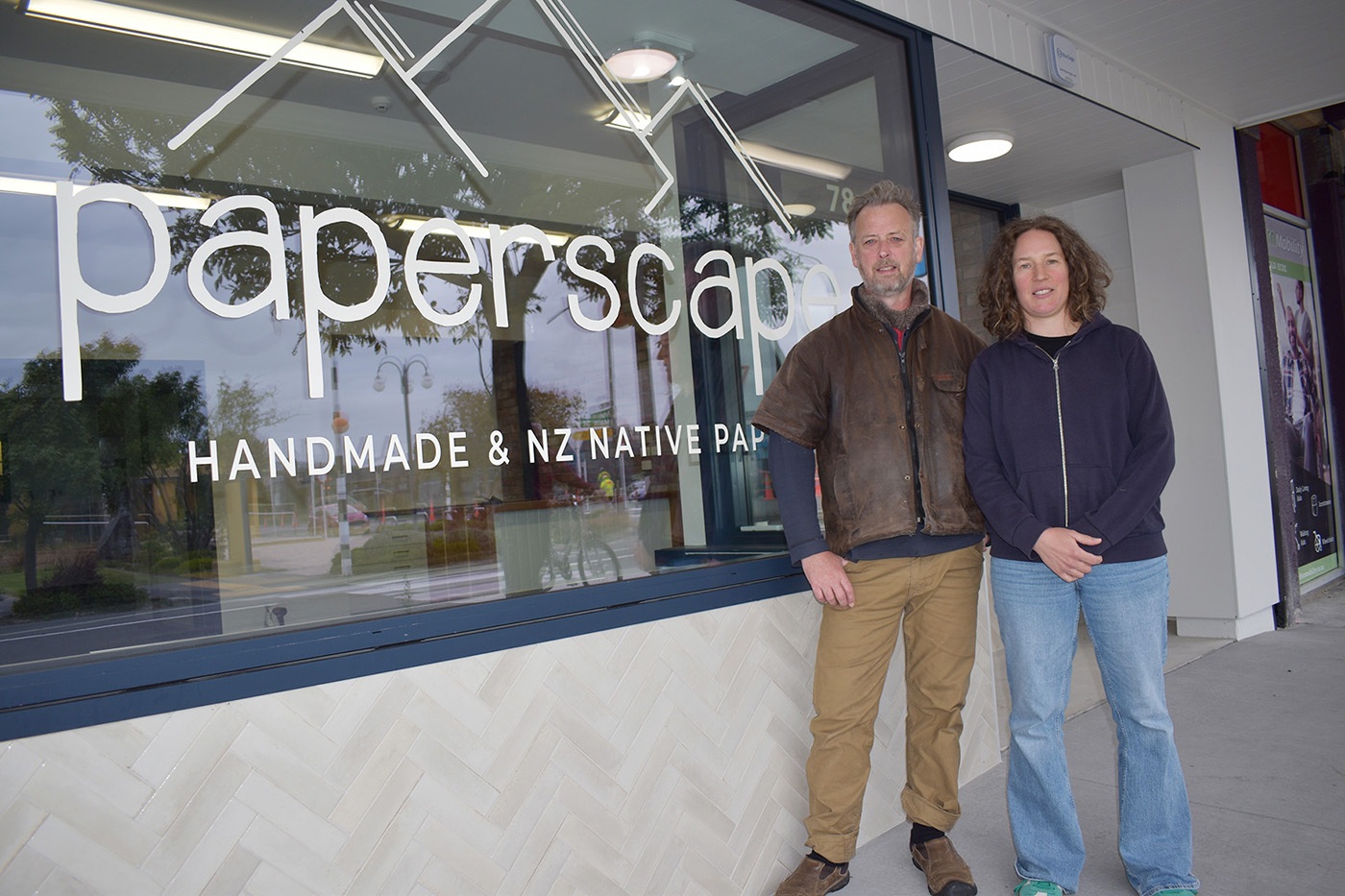
Rob and Katharina Kennedy outside the new Main Street building that will house their Paperscape business. It’s due to open in June. Photo Ōtaki Today
“We liked the fact that it had a retail space, it was in the community, there was foot traffic,” Rob says. “It felt more embedded. At the heart of our operation is the idea of lifting the value of nature by supporting economic activity around conservation goals.”
The Kennedys have lived on the Kāpiti Coast for years, previously operating from Paraparaumu. Rob has been making paper for about 10 years, with Katharina joining the business four years ago.
Paperscape works primarily with non-woody plants – harakeke (flax), cabbage tree, grasses, bamboo and fibrous exotics – rather than timber pulp.
“To extract fibre from trees requires a lot more energy, high pressure systems and chemicals that is often smelly and sulphur-based,” Rob says. “We don’t do that type of pulping.”
Instead, plant material is harvested or received, pulped and processed by hand into sheets. Paperscape produces paper up to A2 size, selling sheets, packs, envelopes, wedding stationery and wrapping paper.
“It’s a very tactile paper. It doesn’t have that industrial blandness a lot of other paper has. Every piece has its own character.”
Katharina says the handmade process leaves distinctive natural edges that customers value.
“It’s not clean and machine-cut. Lots of people like that.”
Their client base is broad. Paperscape supplies to printers, painters, photographers and bookbinders, along with more unusual users.
“We’ve had lampshade makers, a furniture maker using it as backing, film props,” Katharina says. “So really quite a broad range.”
A key point of difference, Rob says, is provenance.
“If you were a wine drinker, you’d talk about the terroir. It’s not just the flavour, it’s the history of its production. Photographers taking landscape photos often want to print on something that is of that place.”
The business also intersects with conservation and te ao Māori values around resource use.
“If you’re going to use something, use it well. Don’t just waste it,” Rob says. “We work with weavers who might not use every part of a plant. That can be passed on and a more complete use can be made.”
The couple are careful not to become an informal green-waste drop-off point. Instead, they hope to build relationships with landowners interested in native planting and sustainable management.
They are keen work with people who have aspirations for revegetation, for example.
They hope to open the retail space around June, initially a few days a week, alongside workshops.
“We’ll offer a classic introduction – a morning making paper,” Rob says. “But we’d also like to go deeper with weekend or six-week courses.”
The aim was to create a welcoming, creative hub where people can see what they do, have a play, make a piece of paper and take a souvenir home.
For the Kennedys, Ōtaki offers the right mix of biodiversity, creativity and community.
“It’s about proving you can have businesses aligned with conservation goals,” Rob said. “When you start to look at that, you realise they’re good values anyway.”
OTHER STORIES
... loading ...
BRIEFS
More police for Ōtaki
Ōtaki police will have three new staff in Ōtaki by the end of the month. Levin Senior Sergeant Sam Gilpin told Ōtaki Today that one was to start in the first week of September, and two were starting later in the month. “This will mean that Ōtaki is near full staffing capacity,” he said. At Levin, the frontline policing roster is full. Two staff from the last graduation started in Levin last month. “With usual attrition this will change so we currently have another five recruits in the college currently, due to graduate in mid October (3), mid November (1) and mid December (1).” Another officer is to start in Foxton mid September.
Expo back October 10
The 2026 Ōtaki Community Expo is in the Memorial Hall on Saturday, October 10, from 10am-2pm. The expo gives community and sporting groups an opportunity to showcase their services. If you're looking to get involved or help out in your community, come and check out the many groups that need support. Morning tea available. If you represent a community group and wish to book a stall, see otakipromogroup.nz/exporego The expo is organised by the Ōtaki Promotions Group.
Kids Market wins
The Ōtaki Kids Market has won the GEN NZ Youth Programme of the Year award, recognising its contribution to inspiring, fostering and supporting entrepreneurial success among young people under the age of 25. The next Kids Market is on Sunday, October 11, at the Ōtaki Market opposite New World.
New rotunda book
A new book, Sunlight and Fresh Air – The Medical Origins of the Ōtaki Rotunda, has been produced by the Friends of the Ōtaki Rotunda. Compiled by retired architect Rob Ansell and edited by historian Jock Phillips, the book tells the story of the rotunda’s architecture. Copies $15, from admin@otakirotunda.org.nz
Kites back March 6-7
The 2027 Ōtaki Kite Festival will be on the weekend of March 6-7.