

 Otaki Today
British actor, director and activist Khalid Abdalla brought a thoughtful and deeply personal perspective to the Māoriland Hub on Saturday during a Native Minds session with filmmaker and broadcaster Tainui Stephens.
Speaking before an engaged audience as part of the Aotearoa New Zealand Festival of the Arts, Khalid reflected on identity, belonging and the experiences that shape his worldview.
With an international acting career that includes roles in the television drama The Crown, the thriller series The Day of the Jackal and the film The Kite Runner, Khalid might have been expected to deliver a fiery address about the political struggles affecting his Egyptian family and the Palestinian genocide.
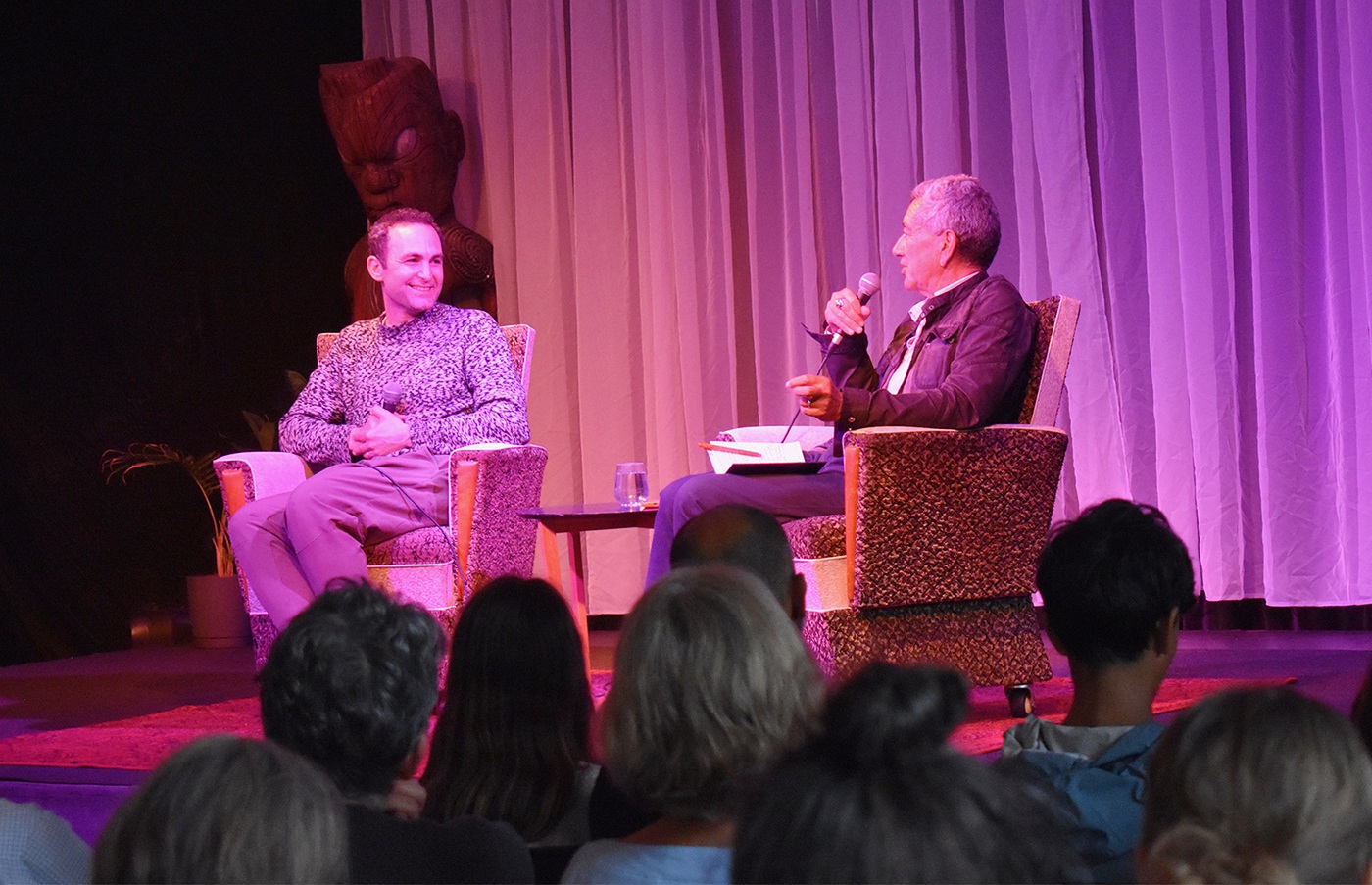
Khalid Abdalla, left, speaks with Tainui Stephens during the Native Minds session. Photo Ōtaki Today
Instead, the conversation unfolded in a measured and reflective tone, with Khalid responding carefully to questions from Tainui and the audience about what was on his “native mind”.
Introducing himself in full, he shared for the first time his real name.
“My name in English is Khalid Abdalla, but my name – and this is the first day in my life I have been invited to say it – is Khalid Hossam Ibrahim Abdalla.”
He spoke about the complexity of his background and sense of identity.
“My nation is a complicated question,” he said. “Both my parents are Egyptian, but I was born in Glasgow. I was brought up bilingual in London.”
He lived primarily in Egypt between 2008 and 2016, a time he described as offering a period of relative safety and connection to his cultural roots.
“I consider myself an Arab,” he said, reflecting on the way identity could span places, languages and experiences.
He discussed his theatre work, particularly his stage production Nowhere, which explored ideas of belonging and displacement. The work became something he carried with him as he travelled and performed around the world.
He likened the play to a vessel that allowed him to create space for conversation and connection.
“Essentially it’s like my waka,” he said, using a metaphor that resonated strongly with the audience.
“It is the vessel that I travel with and that is able in some theatres, in some spaces, in some gatherings, to create enough space for me to speak or feel seen, but also to be with others in a wider family.”
Khalid said his experience at the festival had given him a powerful sense of connection with the creative community in Aotearoa.
During the pōwhiri welcoming guests to the event, he said he felt an unexpected sense of belonging.
“I suddenly felt that I am among my iwi, creatively and culturally,” he said.
The actor also acknowledged the emotional weight he carried as part of the wider Arab world at a time of ongoing violence in Palestine, describing it as something that travels with him wherever he goes. Despite the gravity of those realities, Khalid’s message to the audience remained grounded in empathy, shared humanity and the power of storytelling.
OTHER STORIES
... loading ...
BRIEFS
More police for Ōtaki
Ōtaki police will have three new staff in Ōtaki by the end of the month. Levin Senior Sergeant Sam Gilpin told Ōtaki Today that one was to start in the first week of September, and two were starting later in the month. “This will mean that Ōtaki is near full staffing capacity,” he said. At Levin, the frontline policing roster is full. Two staff from the last graduation started in Levin last month. “With usual attrition this will change so we currently have another five recruits in the college currently, due to graduate in mid October (3), mid November (1) and mid December (1).” Another officer is to start in Foxton mid September.
Expo back October 10
The 2026 Ōtaki Community Expo is in the Memorial Hall on Saturday, October 10, from 10am-2pm. The expo gives community and sporting groups an opportunity to showcase their services. If you're looking to get involved or help out in your community, come and check out the many groups that need support. Morning tea available. If you represent a community group and wish to book a stall, see otakipromogroup.nz/exporego The expo is organised by the Ōtaki Promotions Group.
Kids Market wins
The Ōtaki Kids Market has won the GEN NZ Youth Programme of the Year award, recognising its contribution to inspiring, fostering and supporting entrepreneurial success among young people under the age of 25. The next Kids Market is on Sunday, October 11, at the Ōtaki Market opposite New World.
New rotunda book
A new book, Sunlight and Fresh Air – The Medical Origins of the Ōtaki Rotunda, has been produced by the Friends of the Ōtaki Rotunda. Compiled by retired architect Rob Ansell and edited by historian Jock Phillips, the book tells the story of the rotunda’s architecture. Copies $15, from admin@otakirotunda.org.nz
Kites back March 6-7
The 2027 Ōtaki Kite Festival will be on the weekend of March 6-7.